 |
 |
Spanish Word of the Day
| March 27th, 2014 at 4:49:10 PM permalink | |
| Nareed Member since: Oct 24, 2012 Threads: 346 Posts: 12545 |
As far as I know it means "to fight." It's related to the noun "riña." Specifically it would mean a spontaneous fight, as migth happen after a fender bender.
"Mamá te regañará por jugAR..." I wonder why you didn't use the word of the day in the example. Typo? Donald Trump is a one-term LOSER |
| March 27th, 2014 at 5:05:48 PM permalink | |
| Wizard Administrator Member since: Oct 23, 2012 Threads: 241 Posts: 6108 |
According to SpanishDict.com, it can mean both. The Harry Potter translator uses it to mean scold.
Oops. Add ten push-ups to my tab. Mamá te reñirá por jugar pelota en la casa. Knowledge is Good -- Emil Faber |
| March 27th, 2014 at 5:50:59 PM permalink | |
| Nareed Member since: Oct 24, 2012 Threads: 346 Posts: 12545 |
I've never come across it that way, and I do know more than my share of such uses.
I keep reading "mom will fight you..." Sorry. Donald Trump is a one-term LOSER |
| March 27th, 2014 at 10:05:43 PM permalink | |
| Pacomartin Member since: Oct 24, 2012 Threads: 1068 Posts: 12569 |
Wiz, this is one grammar rule you absolutely have to get correct. It sounds like gibberish to native speakers. Present Participle & Gerunds in English (the -ing form) One example of gerunds (verbs acting like nouns) is after prepositions. Examples are: ... for playing ball in the house. Can you sneeze without opening your mouth? She is good at painting. After skiing, I like to sit in the lodge and drink hot chocolate. In English the gerund is the same form as the present participle (-ing) In Spanish the gerund is the same form as the infinitive (ar,er,ir) The mistake is that you identify the ending (-ando, endo, iendo) with the present participle, following English grammar you will always want to use it for gerunds. Be on the look-out for the form "preposition + 'verb participle ending in 'ing' ". |
| March 28th, 2014 at 7:38:47 AM permalink | |
| Nareed Member since: Oct 24, 2012 Threads: 346 Posts: 12545 |
Actually it's much worse than that. In TV, movies, some books and comic strips, characters portrayed as some kind of ignorant-uncivilized, ethnic stereotype often talk that way. I've no idea if such figures still populate the culture, but they were common in the Americas as late as the 90s. If you recall te old SNL "Tonto, Tarzan and Frankenstein" sketches, think of how Tonto speaks. That's the equivalent here. Donald Trump is a one-term LOSER |
| March 28th, 2014 at 4:26:14 PM permalink | |
| Pacomartin Member since: Oct 24, 2012 Threads: 1068 Posts: 12569 |
Yet the rules of English are completely different on this point. In some cases either form is equally correct: I like to run. I like running. Her favorite fantasy is to play basketball for Denver. Her favorite fantasy is playing basketball for Denver. But after most prepositions we almost always use the -ing form She wrote a newspaper article about dealing with college recruiters. She thanked her coach for helping her to deal with the pressure. But two prepositions, except and but, will sometimes take the "to ..." form. The committee had no choice except to elect Frogbellow chairperson. What is left for us but to pack up our belongings and leave? In the second sentence packing is probably acceptable if you change leave to leaving. |
| April 5th, 2014 at 7:46:23 AM permalink | |
| Wizard Administrator Member since: Oct 23, 2012 Threads: 241 Posts: 6108 | Sorry to ignore the thread lately but I just got back from a week in the Dominican Republic. I have a lot to catch up on, so forgive me if I don't take the time to tell the whole story right now. It is hard to tell if my Spanish is getting any better on a day to day basis. However, I can say I felt a lot more comfortable with the language since my last trip a year ago to Costa Rica and Nicaragua. The DR tends to get gringos from the east coast, where Spanish is not as spoken as the American southwest. Perhaps the locals were impressed and took it easy on me. In places like Can San Lucas and San Felipe a gringo speaking in broken Spanish is nothing new and probably more of an annoyance to the locals. In my never-ending investigation of how to say "hot dog" in Spanish I got four different answers to the locals I bothered. They were: 1. Just "hot dog." 2. Perro Caliente. 3. Salchicha. 4. Jondo. That last one is a new one to the list. I made the woman who said it spell it, and she wrote jondo. Upon doing a little searching, I have no idea where she gets is from. I'll write more about the trip later. For now, here is the ubiquitous Wizard photo. This was taken at the Punta Cana airport upon leaving with Bill, another Bovada affiliate. Click on the photo for a larger version. 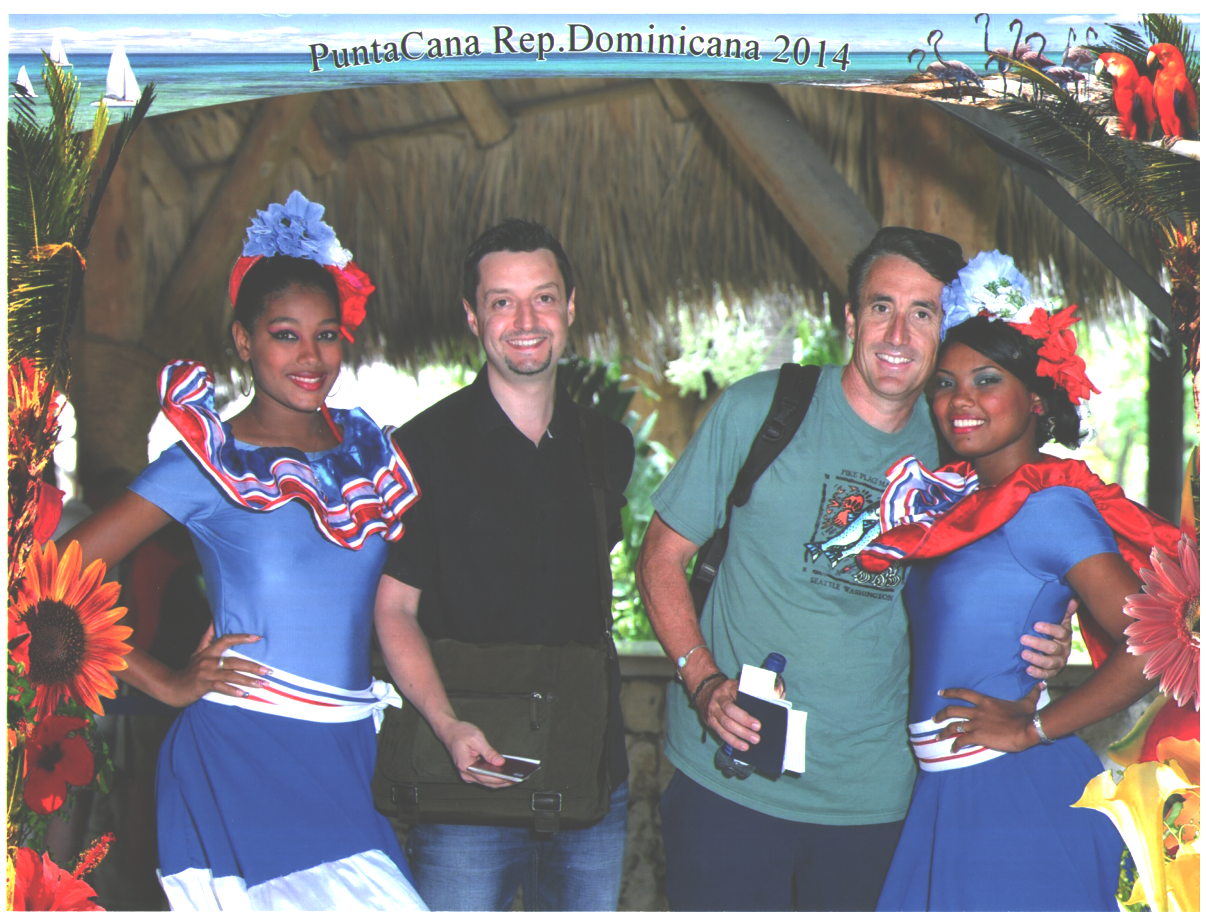 Knowledge is Good -- Emil Faber |
| April 5th, 2014 at 9:25:38 AM permalink | |
| Pacomartin Member since: Oct 24, 2012 Threads: 1068 Posts: 12569 |
Buenaventura Báez intentó anexionar el país a Estados Unidos en 1870's. En esta ocasión, convencería al presidente estadounidense Ulysses S. Grant de enviar barcos de guerra al país caribeño y firmar un tratado de anexión; pese a lo anterior, el Senado no ratificó dicho tratado, lo cual significó una vergüenza para el presidente estadounidense. I bet you didn't know that. I hope you got to fly into Punta Cana airport, as it takes a while to drive out there from the capital as road's are very crowded on that island. My cousin's wife is from Santiago, and they would fly to Punta Cana to avoid the 200 miles of driving. |
| April 5th, 2014 at 11:28:37 AM permalink | |
| Nareed Member since: Oct 24, 2012 Threads: 346 Posts: 12545 |
Anexar. "Anexionar" is not a word. It's kind of like saying "To annexionate" rather than "to annex." Donald Trump is a one-term LOSER |
| April 5th, 2014 at 1:02:15 PM permalink | |
| Pacomartin Member since: Oct 24, 2012 Threads: 1068 Posts: 12569 | anexionar = anexar, especialmente un territorio a otro. (de anexión) Real Academia Española © Todos los derechos reservados But I can see your point. Why not just say anexar? There are an estimated 1.4 million Dominican Americans (including both native and foreign-born) vs 10 milllion population in the Dominican Republic. Ratio of US Latino population (including later generations) to population in native country: 14/100 Dominican Americans 29/100 Mexican Americans 27/100 Salvadoran Americans (could be as high as 32/100) 115/100-136/100 Puerto Ricans in mainland / island If Puerto Rico is an indicator, if DR had become a state, it is possible many more Dominicans would live on the mainland. On the other hand Guadalupe is a state in France with all the rights of any state on the mainland, and they don't have huge numbers of people who immigrate to the mainland. |