 |
 |
Spanish Word of the Day
| March 14th, 2014 at 11:11:16 PM permalink | |
| Wizard Administrator Member since: Oct 23, 2012 Threads: 241 Posts: 6108 |
No hurry. While it is still high on my life, I don't see going anytime soon. Big projects like this are more likely after the kids are grown.
I'm hoping to clear my tab at the WoV spring fling. How about 200 to be done within an hour?
I didn't know that. I was more going after the actual lighthouse function, but you still get full credit. Knowledge is Good -- Emil Faber |
| March 14th, 2014 at 11:48:20 PM permalink | |
| Pacomartin Member since: Oct 24, 2012 Threads: 1068 Posts: 12569 | Many people don't go there since the airport is so small, and flights to the USA consist of one expensive regional jet to Houston. But you can fly to Mexico city and catch a luxury bus right at the airport to Orizaba or Cordoba for $35 to $37 pp 1-way. You could spend one night in the mountains, and head to the beach the next day (roughly 65 miles). It's a delightful city and not as expensive as other beach resorts in Mexico. Spanish is more helpful as there are few English speakers there. |
| March 15th, 2014 at 6:59:15 AM permalink | |
| Wizard Administrator Member since: Oct 23, 2012 Threads: 241 Posts: 6108 | Fecha: 15-3-14 Palabra: Tilma Today's SWD means blanket. Based on the usage I found it in, I tend to think it is a small blanket, perhaps used to cover objects rather than people on a bed. The assignment for the advanced reader is to compare and contrast tilma, y sarape. If it helps, you can mention mantas y cobijas as well, although those were discussed in an earlier SWD. Ejemplo time. El mago produjo un conejo de detrás su tilma. = The magician produced a rabbit from behind his blanket. Knowledge is Good -- Emil Faber |
| March 15th, 2014 at 11:25:41 AM permalink | |
| Pacomartin Member since: Oct 24, 2012 Threads: 1068 Posts: 12569 |
A tilma (also Tilmàtli) was a blanket that was worn as a garment by Aztec men (probably more accurately translated as cloak). The most famous tilma was St. Juan Diego's emblazoned with the Virgin of Guadalupe.  If it was used in the Harry Potter books, I imagine it was the cloak of invisibility,  |
| March 15th, 2014 at 5:47:39 PM permalink | |
| Wizard Administrator Member since: Oct 23, 2012 Threads: 241 Posts: 6108 |
Good guess, but that isn't where I found it. It was in a story of the Virgin Guadalupe and how the guy who first saw her proved it by bringing a bunch of roses to the priest wrapped in a tilma. I could go back and check, but I think the Harry Potter books used capa for the cloak of invisibility. Knowledge is Good -- Emil Faber |
| March 15th, 2014 at 8:43:06 PM permalink | |
| Pacomartin Member since: Oct 24, 2012 Threads: 1068 Posts: 12569 |
Juan Diego wrapped the roses in his cloak, or "tilma". It is essentially almost a blanket since it had no sleeves or other sewing. The men would use them as a sack to pick up and carry things. When he dropped the roses in front of the bishop, her image was in his "tilma". 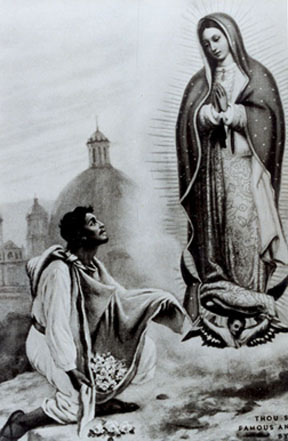 |
| March 16th, 2014 at 7:54:07 PM permalink | |
| Wizard Administrator Member since: Oct 23, 2012 Threads: 241 Posts: 6108 | Fecha: 16-3-14 Palabra: Apetecer Today's SWD means to crave. The assignment for the advanced reader is to confirm or deny a common etymology with the English word Appetite. For extra credit, compare and contrast apetecer y desear. Be careful that apetecer is irregular in the "yo" form of the present tense (apetezco). Ejemplo time. Popeye apetece las espinacas. = Popeye craves spinach. Knowledge is Good -- Emil Faber |
| March 16th, 2014 at 9:53:56 PM permalink | |
| Pacomartin Member since: Oct 24, 2012 Threads: 1068 Posts: 12569 |
Strictly speaking the insertion of letters to preserve the correct pronunciation is not considered "irregular". Some changes to spelling were instituted to Spanish in the 18th century, and the letter ç (the tail is called a cedilla) was eliminated from the language. The modern spelling tries to preserve the pronunciation. Books are by no means uniform in terminology, and some texts call it an irregularity, Incidentally spelling as defined by a regulatory authority is called "orthography" because it defines what we mean by "correct spelling". Sometimes orthography makes definitive spellings that are inconsistent: such as "conceit, deceit, receipt" where only one of the three obvious variations of the same word uses a silent "p".
There is a common etymology, but the word in Spanish is usually not as intense as it is in English. In English we can use the word to imply gluttony, but it never means that in Spanish. That is why the verb "to crave" is used, instead of the more obvious "to have an appetite".  As near as I can tell "desear" runs the same range of emotions in Spanish as it does in English. Depending on context it could mean everything from an inclination to outright lust. But there is a tendency to think of a "strong feeling of want". A lot of these words have changed over time. The verb "to want" was relatively uncommon 400 years ago, but is very frequently used today. The verb "to desire" was used much more often than today. If Shakespeare said "My lord desires you presently" we would automatically assume that the implication is sexual. To Shakespeare it mean "My lord wants to see you soon". |
| March 17th, 2014 at 5:52:45 AM permalink | |
| Nareed Member since: Oct 24, 2012 Threads: 346 Posts: 12545 |
Maybe. it's used so seldom, I can't recall any kind of usage. Donald Trump is a one-term LOSER |
| March 17th, 2014 at 12:01:53 PM permalink | |
| Pacomartin Member since: Oct 24, 2012 Threads: 1068 Posts: 12569 |
The Wizard may like this application Google application to compare frequency of usage in Spanish Compare the frequency of use of the verbs apetecer, desear, querer over the last 300 years. Google application to compare frequency of usage in English Compare the frequency of use of the verbs want, desire, like over the last 300 years. |